
1773–1781
Regulation begins
Parliament begins supervising Company administration.
INDIAN POLITY • CONSTITUTIONAL HISTORY
From a trading company to a government controlled by Parliament
Seven landmark Acts transformed the East India Company from a commercial enterprise into an instrument of British rule under Parliamentary control. Understand the chronology, provisions, offices, councils and changes introduced by each Act.
British Parliament
Ultimate authority rests with Parliament.
East India House
Company supervised by Board of Control.
Court of Directors
Company's administrative and commercial body.
Fort William
Governor-General and his Council.
THE COMPLETE STORY • 1773–1853
Follow the journey from Parliament’s first attempt to regulate the East India Company to administrative centralisation, legislative reform and the move towards competitive civil-service recruitment.
Parliamentary regulation → Judicial correction → Dual control → Charter renewal → Trade monopoly decline → Administrative centralisation → Legislative and recruitment reform
1773–1781
Parliament begins supervising Company administration.
1784
Judicial limits are clarified and the Board of Control is created.
1813–1833
The monopoly is first reduced and then the Company’s commercial role ends.
1853
The legislative structure expands and competitive recruitment becomes the new direction.
Select a year to jump to the Act
1773
Parliament’s first major step to regulate Company administration in India.
Key change: Parliamentary control begins
Current Act1781
Clarified the Supreme Court’s jurisdiction and corrected conflicts created after 1773.
Key change: Judicial correction
Upcoming1784
Created the Board of Control and strengthened British government control over political affairs.
Key change: Dual control
Upcoming1793
Renewed the Company’s charter and largely continued the existing control system.
Key change: Continuity and renewal
Upcoming1813
Ended the Company’s trade monopoly in India, except the tea trade and trade with China.
Key change: Monopoly breached
Upcoming1833
Ended the Company’s commercial activities and made the Governor-General of Bengal the Governor-General of India.
Key change: Administrative centralisation
Upcoming1853
Separated the legislative and executive work of the Governor-General’s Council and opened the way for competitive civil-service recruitment.
Key change: Legislative evolution
Upcoming1773 Control → 1781 Correction → 1784 Dual Control → 1793 Continuity → 1813 Monopoly Reduced → 1833 Trade Ends → 1853 Council Evolves
Tip: Learn the Master Memory Path first, then the Seven Acts in order.
The Company’s territorial and revenue power had grown, but its administration faced financial stress, corruption complaints and weak accountability. Parliament intervened because a commercial corporation was now exercising governmental power.
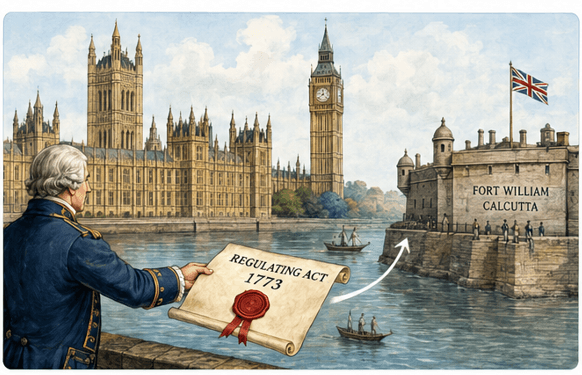
The first major Parliamentary measure to regulate the Company’s territorial administration in India.
The Governor of Bengal was elevated to the Governor-General of Fort William in Bengal, commonly called the Governor-General of Bengal.
Warren Hastings became the first Governor-General under this arrangement.
The Governor-General worked with a four-member Council. Ordinary decisions were taken by majority, with a casting vote for the Governor-General in a tie.
Madras and Bombay were placed under Bengal’s superior control in specified important matters, especially war and treaty policy.
The Act provided for a Supreme Court at Fort William. The Court was actually established in 1774 through the Crown’s Letters Patent.
Company correspondence concerning revenue, civil and military affairs had to be reported to British authorities.
In specified important matters, especially war and treaty policy
| Statutory provision | Regulating Act, 1773 |
|---|---|
| Establishing instrument | Letters Patent dated 26 March 1774 |
| Location | Fort William at Calcutta |
| Composition | 1 Chief Justice + 3 puisne judges |
| First Chief Justice | Sir Elijah Impey |
| Appeal | King-in-Council |
These conflicts led to the corrective Act of 1781.
Act of Settlement, 1781
Jurisdiction clarifiedAlso known as the Amending or Declaratory Act
The Regulating Act provided for a Supreme Court, which was established at Calcutta in 1774. However, the limits of the Court’s jurisdiction were not sufficiently clear in practice. Conflicts arose with the Governor-General-in-Council, Company officials, revenue administration and the Company’s courts outside Calcutta. Parliament therefore intervened again to clarify judicial authority.
Problem
The Supreme Court’s practical reach was interpreted broadly.
Conflict
Judicial process collided with revenue administration, official acts and Company courts.
Correction
The 1781 Act clarified boundaries and protected specified administrative functions.
Before 1781 — Overlap & conflict
Unclear limits → jurisdictional conflict
After 1781 — Clearer boundaries
It amended and clarified the judicial-administration provisions associated with the Regulating Act, 1773.
The Governor-General and Council were protected from the Supreme Court’s jurisdiction for acts done or ordered in their official public capacity within their authority.
This was protection for specified official acts, not unlimited personal immunity.
Persons acting under lawful official authority were protected from ordinary judicial interference for those authorised public acts.
The Supreme Court’s jurisdiction was excluded from revenue matters and acts connected with revenue collection when performed under the authorised administrative system.
The Supreme Court retained jurisdiction over persons within Calcutta, while its reach over Indians and administrative matters in the mofussil was narrowed and clarified.
In relevant civil and family matters, the Court was required to respect the applicable laws and usages of Hindus and Muslims instead of automatically applying English rules.
The Company’s provincial judicial arrangements outside Calcutta received clearer recognition within the administrative system.
Appeals from the Company’s provincial civil courts were directed to the Governor-General-in-Council through the Sadar Diwani Adalat arrangement, rather than treating the Supreme Court as their regular appellate court.
The Governor-General-in-Council was empowered to frame regulations for the Provincial Courts and Councils.
Calcutta
Mofussil • Areas outside Calcutta
The Act did not abolish the Supreme Court. It defined limits between the Crown’s Court at Calcutta and the Company’s administrative and judicial machinery outside it.
| Aspect | After 1773 | Correction in 1781 |
|---|---|---|
| Supreme Court | Court established in 1774, but jurisdictional conflicts emerged | Jurisdiction was clarified and narrowed in specified areas |
| Official acts | Court intervention produced conflict with administration | Specified public-capacity acts received protection |
| Revenue | Revenue administration faced judicial interference | Revenue matters were placed outside the Court’s jurisdiction |
| Mofussil justice | Crown Court and Company-court boundaries were disputed | Provincial Company courts and their appellate route were clarified |
| Personal laws | Application of English law created uncertainty and conflict | Applicable Hindu and Muslim laws and usages received statutory respect |
After 1773: Court established in 1774, but jurisdictional conflicts emerged
1781 correction: Jurisdiction was clarified and narrowed in specified areas
After 1773: Court intervention produced conflict with administration
1781 correction: Specified public-capacity acts received protection
After 1773: Revenue administration faced judicial interference
1781 correction: Revenue matters were placed outside the Court’s jurisdiction
After 1773: Crown Court and Company-court boundaries were disputed
1781 correction: Provincial Company courts and their appellate route were clarified
After 1773: Application of English law created uncertainty and conflict
1781 correction: Applicable Hindu and Muslim laws and usages received statutory respect
The corrective statute required the judicial system to respect the applicable laws and usages of Hindu and Muslim inhabitants in relevant matters. This limited the automatic displacement of local personal law by English legal rules.
In relevant matters
The Patna litigation highlighted questions about the Supreme Court’s reach into the mofussil, the treatment of Company judicial proceedings and the applicable law for Indian parties.
The attempt to enforce Supreme Court process outside Calcutta produced a direct confrontation with Company authorities and exposed the uncertainty over jurisdiction.
The Act reduced major areas of conflict by limiting the Supreme Court’s interference in revenue and specified official acts, clarifying the place of Company courts and respecting applicable personal laws. However, it was mainly a judicial and administrative correction. The broader question of political control over the Company remained and was addressed more directly in 1784.
Judicial boundaries were corrected; political control came next.
1773: Regulation begins → 1774: Supreme Court established → Conflicts emerge → 1781: Jurisdiction corrected